Building Professional Fluency: The Corporate Jargon Worth Knowing
There’s a moment that almost everyone experiences when they enter a new workplace, especially when that workplace is in another country or culture. You’re sitting in a meeting, listening carefully, and suddenly someone says, “Let’s touch base later,” another person says they’ll “circle back,” and your manager asks everyone to have something ready by EOD. You understand every individual word, but somehow the sentence still feels like a different language.
If you’ve ever experienced that, don’t worry. You’re not behind, and you’re certainly not less qualified. Corporate jargon is simply another form of workplace language, and like any language, it takes a little time to become familiar with.
For anyone preparing to work for companies in the US, UK, Canada, Australia, Europe, or international companies that operate in English, understanding common workplace terminology can be surprisingly valuable. Many of these expressions are now used across the global corporate world, not just in the West.
You don’t need to know every corporate phrase before your first day. In fact, you don't even need to use most of them yourself. But knowing what people mean when they use them can make meetings, emails, interviews and everyday conversations much easier to navigate.
Why Learning Corporate Jargon Actually Matters
Corporate jargon sometimes gets mocked, and understandably so. There are phrases that can make a very simple idea sound unnecessarily complicated. But underneath all the buzzwords, there is a practical reason these expressions continue to exist: they have become part of how many workplaces communicate.
Imagine your manager says, “Let's take this offline and circle back once we've aligned with the stakeholders.” If you don't know those expressions, you might spend the next few minutes trying to work out what is actually being asked of you. Once you understand the terminology, however, the sentence becomes straightforward: discuss it separately, then return to the issue after speaking with the relevant people.
That understanding matters because your professional ability isn't only about what you can do. It is also about how effectively you can communicate, understand instructions, participate in meetings and work with other people.
This is particularly important when you're entering a new employment market. You may already have excellent technical skills, strong academic qualifications or years of experience, but unfamiliar workplace language can still create an unnecessary barrier.
Think of it as professional fluency. The more familiar you become with the language of the workplace, the easier it becomes to concentrate on your actual contribution instead of constantly trying to decode what everyone is saying.
The Corporate Jargon Worth Knowing
Here are some of the expressions you're likely to hear in modern workplaces.
Everyday Workplace Expressions
Touch base — Have a quick conversation or check in with someone.
Circle back — Return to a topic or conversation later.
Take this offline — Discuss something separately rather than continuing the discussion in the current meeting or group setting.
Keep me in the loop — Keep me updated about what is happening.
On my radar — Something you're aware of or paying attention to.
Get back to you — Respond or provide an answer later.
Moving forward — From this point onward.
EOD (End of Day) — By the end of the working day.
EOW (End of Week) — By the end of the working week.
EOM (End of Month) — By the end of the month.
ASAP (As Soon As Possible) — As soon as reasonably possible.
FYI (For Your Information) — Information being shared for someone's awareness.
Heads-up — An advance warning or notification about something.
Flag this — Bring attention to something important.
Follow up — Contact someone again regarding something previously discussed.
Action item — A specific task that needs to be completed, usually assigned to a particular person.
Meetings & Communication
Let's align — Make sure everyone agrees or has the same understanding.
Get everyone on the same page — Make sure everyone understands the situation, expectations or plan in the same way.
Sync up — Communicate or meet to coordinate with one another.
Quick sync — A short meeting or conversation to discuss something.
Touchpoint — A point of communication or interaction.
Stakeholder — A person or group that is involved in, affected by, or has an interest in a project or decision.
Buy-in — Support or agreement from the people whose approval matters.
Bandwidth — The amount of time, capacity or resources someone has available.
For example, when someone says, “I don't have the bandwidth this week,” they usually mean they don't have enough time or capacity to take on additional work.
Let's unpack that — Examine or explain an idea in greater detail.
Let's dig into this — Investigate or explore something more deeply.
Let's connect — Have a conversation, often at a later time.
Project & Strategy Jargon
Low-hanging fruit — An easy opportunity or task that can produce a useful result with relatively little effort.
Move the needle — Make a meaningful or noticeable difference.
Boil the ocean — Try to accomplish too much at once or attempt an unnecessarily enormous task.
Think outside the box — Approach a problem creatively or in an unconventional way.
Deep dive — Examine a subject in considerable detail.
Big picture — The overall situation rather than the smaller details.
Drill down — Examine something at a more detailed level.
At a high level — Discuss something broadly without going into all the details.
Roadmap — A plan showing the direction, stages or major objectives of a project, product or business.
Pain point — A problem or frustration experienced by a customer, employee or business.
Quick win — Something relatively easy that can produce a useful result quickly.
Value proposition — The specific value or benefit a product, service or idea offers.
North Star — The primary objective or guiding goal that helps a team stay focused.
Best practice — A method or approach generally considered effective or successful.
Scalable — Able to grow without requiring a proportional increase in resources.
Streamline — Simplify a process and make it more efficient.
Optimize — Improve something to achieve better performance or results.
Team & Workplace Expressions
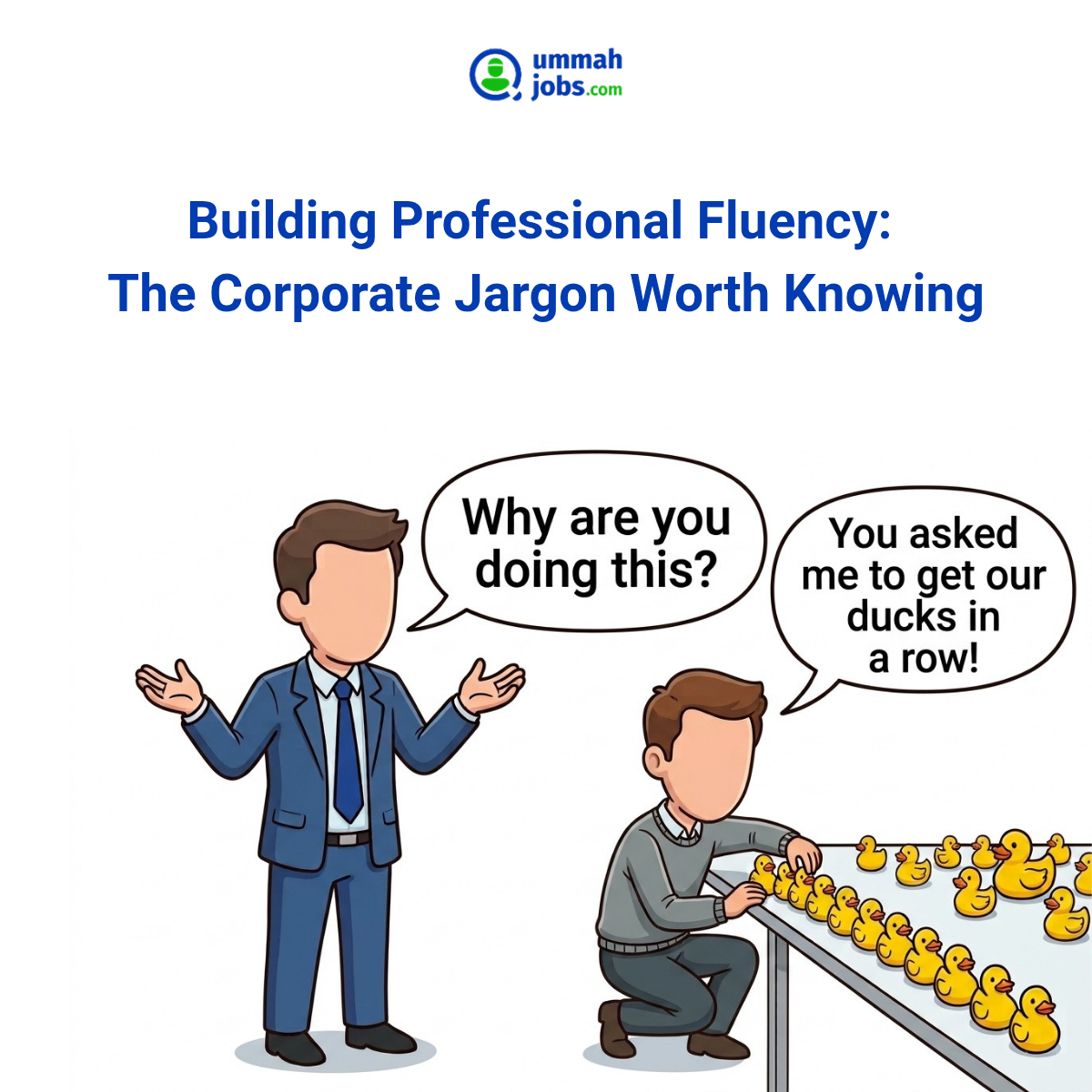
Keep your ducks in a row — Make sure everything is organized, prepared and in order.
Step up — Take on more responsibility or initiative.
Take ownership — Accept responsibility for something and make sure it gets completed.
Be proactive — Take action before being asked or before a problem develops.
Raise the bar — Increase the standard or level of performance.
Go the extra mile — Put in additional effort beyond what is normally expected.
Pull your weight — Contribute your fair share to a team or project.
Get the ball rolling — Start a project, conversation or process.
Get up to speed — Become familiar with the information, situation or work involved.
Hit the ground running — Start a new role or project effectively and quickly.
Wear many hats — Have several different responsibilities or roles.
Learn the ropes — Learn how a particular job, organization or process works.
Keep things on track — Make sure a project or activity continues according to plan.
Off track — Moving away from the intended plan, objective or schedule.
Performance & Business Language
KPI (Key Performance Indicator) — A measurable value used to evaluate performance or progress.
OKR (Objectives and Key Results) — A goal-setting framework used to define objectives and measurable results.
ROI (Return on Investment) — The value gained compared with the resources or money invested.
Deliverable — A specific piece of work expected to be completed as part of a project.
Deadline — The date or time by which something needs to be completed.
Target — A specific result or level of performance that someone is expected to achieve.
Milestone — An important stage, event or achievement within a project.
Quarter / Q1 / Q2 / Q3 / Q4 — A three-month period used for business planning, reporting and financial measurement.
Top line — Generally refers to revenue.
Bottom line — Generally refers to profit or the final financial result.
Forecast — An estimate of future performance, revenue, demand or other business outcomes.
Pipeline — Potential business, sales opportunities, projects or work currently being developed.
Onboarding — The process of introducing a new employee, client or customer to a company, team or system.
Offboarding — The process of managing someone's departure from a company or system.
And Then There Are the Acronyms
If corporate jargon is one language, corporate acronyms are almost another one.
You’ll see them everywhere, particularly in emails, job descriptions, meetings and internal documents. Some are industry-specific, while others are so common that you will encounter them in almost any professional environment.
Here are some of the most useful ones to recognize:
EOD — End of Day
EOW — End of Week
EOM — End of Month
ETA — Estimated Time of Arrival / Expected completion time
FYI — For Your Information
ASAP — As Soon As Possible
TBD — To Be Determined
TBC — To Be Confirmed
OOO — Out of Office
WFH — Work From Home
PTO — Paid Time Off
KPI — Key Performance Indicator
OKR — Objectives and Key Results
ROI — Return on Investment
SOP — Standard Operating Procedure
FAQ — Frequently Asked Questions
B2B — Business to Business
B2C — Business to Consumer
HR — Human Resources
PR — Public Relations
VP — Vice President
CEO — Chief Executive Officer
COO — Chief Operating Officer
CFO — Chief Financial Officer
CTO — Chief Technology Officer
There are countless others, particularly once you move into specific industries such as technology, finance, marketing, healthcare, consulting or engineering. You don't need to memorize all of them. The important thing is to become comfortable learning new terminology as you encounter it.
Don't Learn It Just to Sound Corporate
There is one thing worth remembering: learning corporate jargon does not mean you should start putting buzzwords into every sentence.
Nobody needs to walk into their first interview saying they want to “leverage synergies and move the needle across cross-functional verticals.” That will probably sound worse than simply explaining what they actually want to accomplish.
The purpose of learning workplace terminology is understanding, not performance.
If you hear an unfamiliar phrase in a meeting, ask about it. If an acronym appears in an email that you don't understand, look it up. If your manager uses a term you've never encountered before, remember it and learn what it means.
That's how professional fluency develops.
Nobody enters their first corporate job knowing everything. Even experienced professionals encounter new terminology when they move between industries, companies or countries.
From Skills to Professional Confidence
Your technical skills, experience, education and ability to do the actual job will always matter more than knowing a collection of buzzwords. Jargon alone won't get you hired.
But being able to understand workplace communication can remove one more obstacle between you and the opportunities you're pursuing.
It can help you follow meetings more easily, understand emails faster, communicate with colleagues more confidently and ask better questions. Over time, that familiarity contributes to something bigger: becoming a more polished professional.
And perhaps that's the best way to look at corporate jargon.
You don't learn it because you're supposed to know everything. You learn it because every new piece of knowledge makes the professional world a little less unfamiliar.
So if you're preparing for your first job, applying to companies abroad, moving into a new industry or simply trying to become more confident in professional English, start learning the language around the work.
You already have your skills.
Now make sure you can confidently navigate the room where those skills are being discussed.